


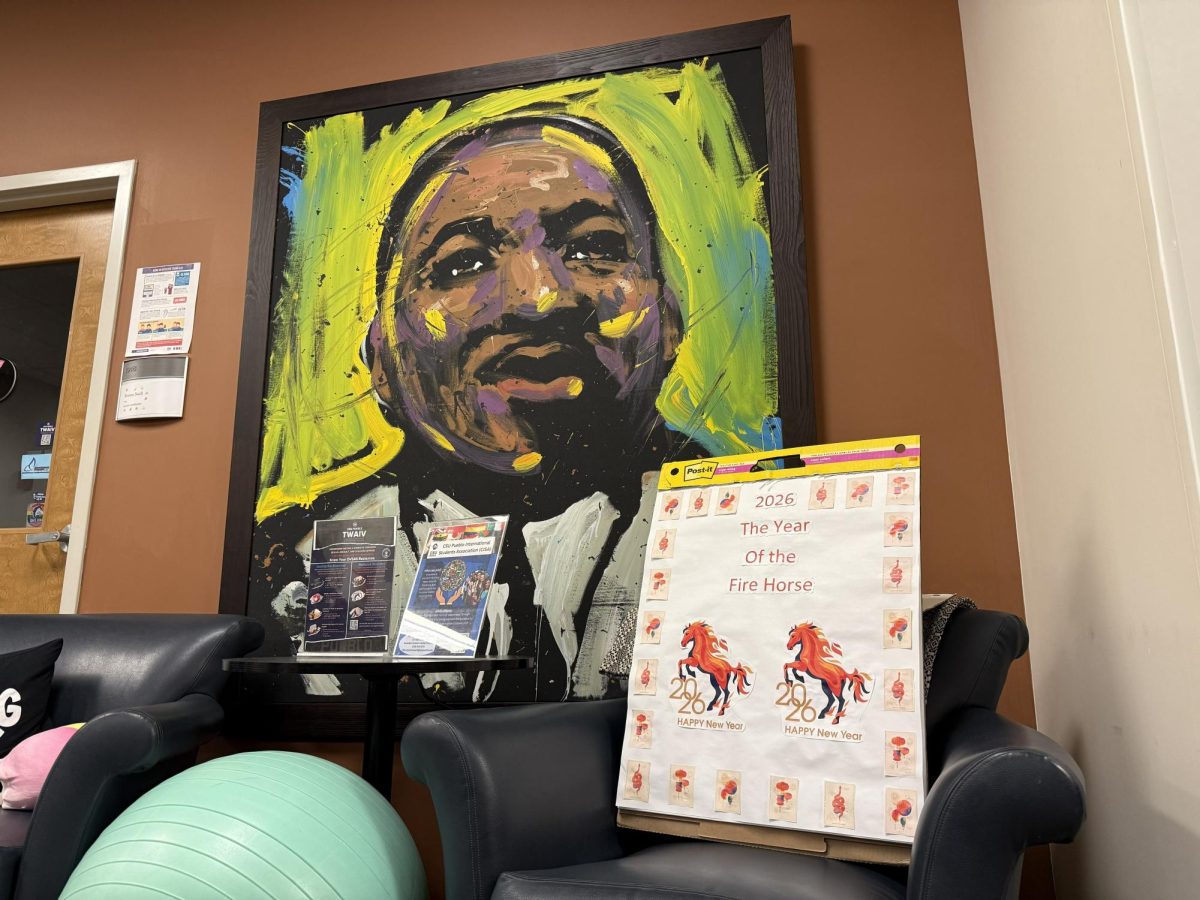
Feb. 17 marks a several-day-long tradition within various Asian countries – Lunar New Year. Taking place in the Center for Student Support and Advocacy, located in the Occhioto Student Center, students gathered to discover more about the celebration’s history, grab a refreshment, and connect with one another.
While Lunar New Year is a time to honor ancestors and reconnect with family, it began with a way to mark the turn of the year in non-western cultures, including Asian, Islamic, and Buddhist cultures. Historically, western countries operated on the Gregorian calendar, which is what most commonly is used today. The Gregorian calendar follows a solar cycle, while a Lunisolar calendar follows a lunar cycle, which counts the days of the year differently according to the shifts of the sun and moon.
For some, a Gregorian calendar is used for secular life in order to align daily life with other cultures. However, Chinese and Hebrew cultures use the Lunisolar calendar to mark traditional holidays.
The Lunar New Year also marks a new revolution in the Chinese Zodiac, with 2026 becoming the year of the horse. Every year, a new animal is recognized according to the Zodiac.
To provide students a place to celebrate Lunar New Year traditions, which can vary depending on country, the CSU Pueblo International Students Association (CISA) collaborated with the Center for Student Support and Advocacy and the Asian, Asian Pacific, Asian Pacific Islander Student association (AAPISA).
In addition to the Lunar New Year celebration, more events are being hosted around campus in the following week:
- Lunar New Year – Karaoke Social | Feb. 23 | 5-7 p.m. in the Occhiato Student Center Fireplace Lounge
- Mahjong & Lantern Making | Feb. 24 | 3-4 p.m. in the Center for Student Support and Advocacy
- Lunar New Year Trivia | Feb. 25 | 4-5 p.m. in the Center for Student Support and Advocacy
Lilia Meyers Van Pelt, the international student advisor and programming coordinator at CSU Pueblo noted how these kinds of events are a draw for not only students, but anyone on campus.
“One of the functions of the center is to try to bring folks from all across campus together,” Meyers Van Pelt said. “Our office is all about providing services and assistance to individuals across campus. I really say individuals, not just students, because through Pack Cares and Pack Pantry, anyone can access assistance.”
The Center is also host to a variety of resources for everyone associated with the University, including study abroad programs, disability resources, and the Pack Pantry.