

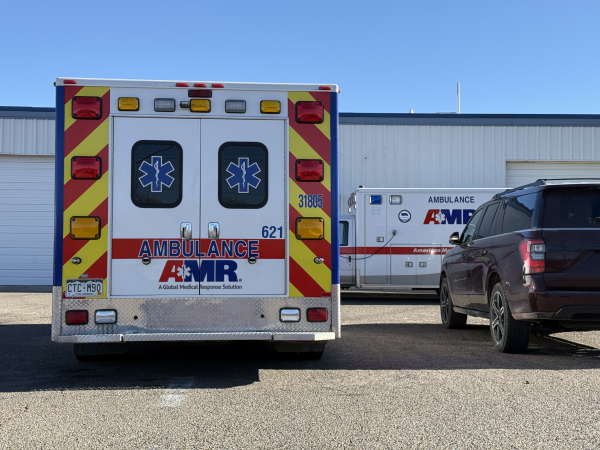
American Medical Response, more commonly known as AMR, is a name that many Puebloans recognize plastered on the sides of medical response units throughout the city, as a sponsor for local events or on their way to aid the community.
Mike Lening, AMR Operations Manager for Pueblo and Canon City, has been in the emergency response field for over thirty years; starting as an Emergency Medical Technician (EMT) and working his way up through emergency medical services (EMS) before AMR’s takeover in 1994. Since his start, resources have changed significantly.
“The equipment these days is very expensive. For a locally owned company, it would be challenging to match the resource capability [of AMR]. We’re about 120 employees now,” Lening said while discussing the services that AMR has provided for the community over the last 30 years. “That’s about a fifty-fifty ratio of paramedics to EMTs.”
While both are emergency medical professionals, paramedics receive a higher degree of training to provide advanced medical care in the field, accompanied by an EMT.
Typically, around 11 ambulances are deployed each day, all twenty-four hours of the day. These vehicles are spread across Pueblo, with their locations shifted occasionally as personnel respond to emergency calls in order to maximize coverage. AMR provides these vehicles, medical supplies, and has collaborated with other local healthcare sources like UCHealth to provide more resources for EMS staff such as blood for in-ambulance transfusions.
Pueblo AMR also boasts a number of waivers, which allows them to provide medical care beyond the usual scope. This can include medications and the types of care they are allowed to administer.
Unfortunately, not every Puebloan has affordable access to this care.
Refusing healthcare, which cannot be administered by EMS if a patient verbally refuses, is an issue that several Puebloans without insurance face. This especially affects demographics, such as those with substance abuse disorders or unhoused individuals.
Emergency transportation services like the kind that AMR provides are under the Department of Transportation andare categorized as such by insurance companies like Medicare, Medicaid, and some private insurances. While a patient receives medical care within that ambulance, effectively functioning as a mobile emergency room until they reach a hospital, that service is seen as transportation instead of healthcare. One of the largest challenges that AMR faces is getting reimbursed by insurance companies for the services they provide.
This reimbursement helps drive revenue for medical supplies and salaries for AMR staff, who currently face the same issue that several healthcare fields are experiencing; shortages.
“I think EMS is a little bit of a niche,” Dawn Mathis said, the EMS education department chair at Pueblo Community College. “It’s not for everyone. People that want to go into healthcare largely think of doctors or nurses. People just aren’t that familiar with EMS.”
EMS doesn’t just fall directly on AMR though. The Pueblo Fire Department is also taking steps in providing care to the community.
The Pueblo Fire Department employs around 60% staff who have Advanced Life Support (ALS) training, with several EMTs or paramedics transferring into fire later in their careers.
The Directing Others to Services (D.O.T.S.) program, hosted by Pueblo Fire, is another support program aiming to assist people who may not be experiencing a medical emergency. Addiction counseling, mental health care, or people who simply need a care provider after hours may be key candidates to use the program.
Kelly Firestone, a Pueblo firefighter who is responsible for the D.O.T.S. program, has been working since 2019 to provide the community connect to resources that they may not know about or may not be capable of connecting with themselves.
When these calls are processed through 911, an operator may send the person in need someone from the D.O.T.S. program if it’s not a medical emergency. This frees up both ambulances and fire engines for higher acuity cases. If someone needs help at home, does not have a doctor or is unaware they are eligible for Medicaid, lack of home healthcare, food, or transportation needs then the program typically handles it.
Through D.O.T.S., individuals who may not have family to care for them or have difficulty accessing resources due to disability are cared for. This can even be as simple as making appointments for clients. The program works closely with the Department of Human Resources and The Resources Exchange to ensure that clients who wind up with them are continuously cared for.
“Once they get our number, they know they can call us. Even when we stop seeing them on a regular basis, they know that they can always call if something comes up months later, a year later, weeks later, whatever,” Firestone said.
Partnerships between emergency service programs in Pueblo have been a key part in providing for the community throughout the years, with the goal for both D.O.T.S. and AMR to continue expanding their services.